

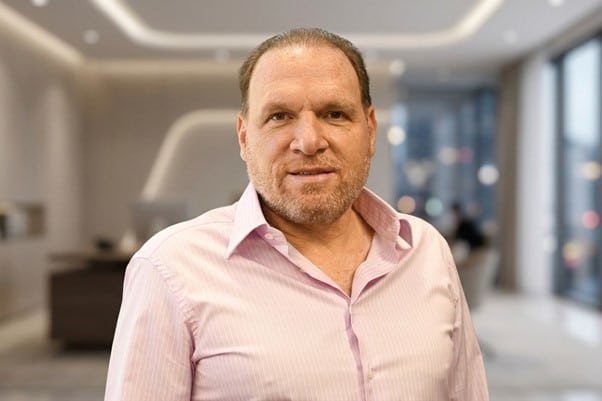
Linked to the fruit business for more than 30 years, Massuh arrived in Chile from Ecuador after studying Agronomy at Cornell and Business in Florida. In Chile he founded Bagno, one of the country’s largest importers of bananas and tropical fruits. Challenging myths and prejudices, he is now a successful entrepreneur who decided that this South American country would be the place to build his future.
Entrepreneurial trajectories are often explained through results: companies founded, markets conquered, or growth figures achieved.
However, in many cases the true origin of a business project lies in something less visible: the way a person learns to interpret work, risk, and time.
The story of Gabriel Massuh is better understood from that starting point. Before becoming a relevant figure in Chile’s fruit trade, his relationship with agriculture began as a daily experience.
Born in Guayaquil, Ecuador, he grew up in an environment where the countryside is part of productive life. In that context, agriculture functioned as a quiet school of discipline.
Natural processes such as planting, waiting, and harvesting teach a logic that later proves useful in business. According to Massuh, “not everything can be accelerated, and every stage depends on the previous one.” This perspective would shape the way he approached entrepreneurship years later.
Entrepreneurship: an early decision
His curiosity about how the agricultural sector works led him to seek education outside Ecuador. He studied Agronomy at Cornell, one of the most recognized academic institutions in the United States, and later complemented that foundation with Business studies in Florida.
The combination of technical knowledge and commercial vision allowed him to understand something that many producers do not see clearly: agriculture does not end in the field—it continues in the market.
In 1993, when he was just over twenty years old, Gabriel Massuh made a decision that would define his career: moving to Chile. The country offered economic stability and a growing market, but it also represented a completely new environment for a young entrepreneur without local networks. His initial goal was simple: importing fruit.
The first years in Chile were marked by the need to prove his capabilities in a demanding environment. Massuh explains that “starting a business as a young migrant without contacts in the industry meant facing a natural initial distrust in a sector where commercial relationships are built slowly.”
In this context, Massuh decided to move forward with a small importing company. The challenge was not only commercial. It also required understanding the country’s logistics, the pace of the market, and the quality standards demanded by distributors and wholesalers.
The learning process was gradual. Instead of pursuing immediate expansion, the focus was on consolidating relationships and demonstrating reliability in every operation.
Understanding the market and growing responsibly
That process culminated in the creation and later consolidation of Bagno, a company that over time would become a recognized player in the import and distribution of tropical fruits.
In the early 1990s, Chile showed increasing consumption of tropical fruits. However, the country does not produce these crops locally, which means that supply depends entirely on international trade.
Among these products, bananas occupied a central place in the national diet. Massuh identified a structural market condition that represented an opportunity to build a strong position.
His strategy was not based on rapid growth but on building credibility. In agricultural trade, where products are perishable and logistics are critical, trust between suppliers and buyers is a central asset.
Over time, Bagno expanded its portfolio with mango, pineapple, citrus fruits, and avocados, while also strengthening its networks with international suppliers and local producers.
Massuh: “Difficult moments also shape an entrepreneur”
No long entrepreneurial journey is free from complex episodes. In Bagno’s case, tax audits related to operations between 2013 and 2016 led to tax assessments that were later challenged.
The process was resolved in January 2025, when the Tax and Customs Court of the Metropolitan Region annulled the assessments issued by the Internal Revenue Service, pointing out flaws in the administrative procedure.
Beyond the legal outcome, the episode tested the company’s institutional structure and its ability to respond under pressure.
Rather than a story of rapid growth, Massuh’s experience illustrates how a business can develop through persistence, continuous learning, and a deep understanding of the market.