The Multi-Million Dollar Shovel: Why Digital Documentation is Your Only Defense in Utility Damage Litigation
The utility industry operates under a unique pressure: a single mistake in the field can lead to catastrophic loss of life, environmental disaster, and financial ruin. Despite the rigorous efforts of the Common Ground Alliance (CGA) and the nationwide 811 system, utility strikes happen every day.
When a gas main is struck or a fiber optic backbone is severed, the immediate priority is safety. But once the dust settles, the secondary crisis begins: Liability.
In the ensuing legal and regulatory battle, the question is rarely “Did you locate the line?” The question is “Can you prove you located the line accurately, on time, and communicated that status clearly?”
For operators relying on paper maps, radio logs, and disjointed email chains, this is a losing battle. The only effective defense in the modern regulatory landscape is a Digital Manifest.
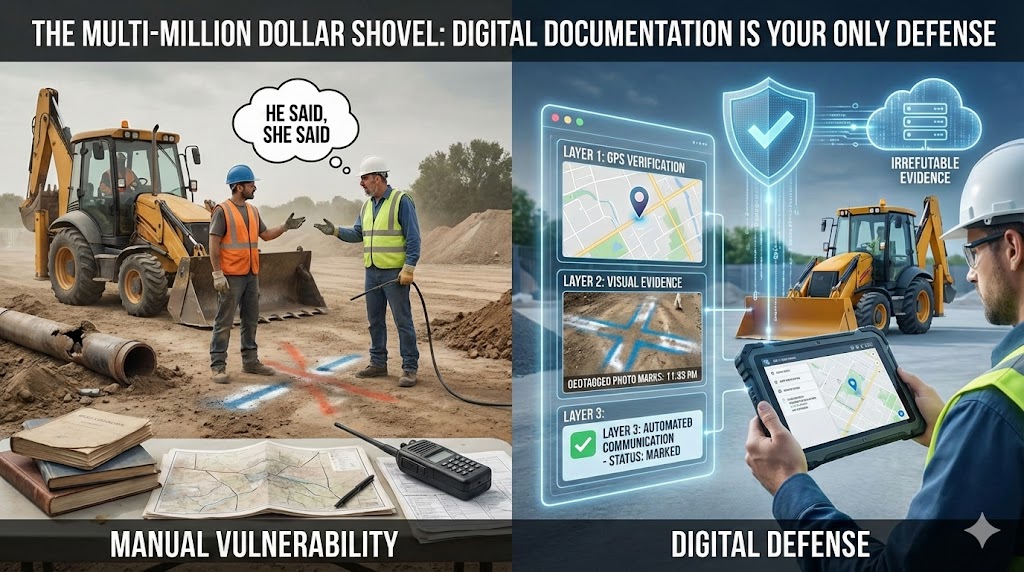
The Anatomy of a “He Said, She Said” Dispute
Consider the classic scenario: An excavator hits a water main. They claim, “There were no blue marks on the ground.” The utility locator claims, “I marked that site three days ago.”
Without evidence, the utility is often held liable. Paint fades. Flags are removed by lawnmowers or neighborhood children. Rain washes away chalk. If your only proof is a checkmark in a logbook, you are exposed.
Building the Digital Fortress with One Call Software
Modern One Call Ticket Management solutions, such as BOSS811, transform the locating process from a manual task into a data-driven compliance engine. This protects the utility through three distinct layers of digital evidence.
Layer 1: Geospatial Verification (The “Where”)
It is no longer enough to say a locator was on site. Modern mobile apps track the GPS coordinates of the locator’s device when they acknowledge and close a ticket. This creates a digital breadcrumb trail proving that the technician physically walked the site, eliminating the risk of “drive-by” locates.
Layer 2: Visual Evidence (The “What”)
The most critical feature of modern 811 software is the ability to attach media to the ticket record. Before leaving the site, the locator takes high-resolution, timestamped, and geotagged photos of the marks relative to permanent landmarks (curbs, poles, houses).
When the excavator claims “there were no marks,” the utility can produce a photo taken 48 hours prior, showing clear paint exactly where the strike occurred. This visual evidence is virtually irrefutable in court and can prevent a lawsuit from ever being filed.
Layer 3: Automated Communication (The “When”)
Many damages occur because the excavator was unsure if it was safe to dig. Automated Positive Response systems close this communication gap. The moment the locator closes the ticket on their tablet, the system automatically transmits the status (Marked, Clear, No Conflict) to the State One Call Center and the excavator. This creates a timestamped audit trail proving that the utility met its legal deadline to respond.
Conclusion: Data is Your Insurance Policy
Investing in a robust 811 ticket management system is not just an operational expense; it is a risk management imperative. The cost of a single utility strike—comprising repair costs, regulatory fines, legal fees, and reputational damage—can easily exceed the cost of the software for a decade.
In the high-stakes world of excavation, you cannot control every backhoe operator. But you can control your data. By digitizing your workflow, you move from a position of vulnerability to a position of strength, ensuring that when the shovel hits the ground, your organization is protected.